Transforming a 2-Hour Job into a 2-Minute Process
How rethinking system level behavior unlocked a 60× performance improvement with zero schema changes.
Overview
A core production job required nearly two hours to process each 5,000‑record batch. Multiple consulting teams had reviewed the issue over the years, proposing incremental tweaks but failing to produce meaningful improvements. The long runtime was considered unavoidable and became the accepted norm.
The Challenge
- Batch job took ~2 hours per 5,000 transactions.
- Consulting teams recommended only small efficiency tweaks.
- Root cause remained undetected for years.
- Any key or data‑structure change was considered too risky or expensive.
My Approach
Instead of focusing solely on the code trail—as previous teams had—I analyzed the system interactions and execution flow. The core suspicion: unnecessary system calls causing massive overhead.
1. System‑Level Analysis
- Reviewed complete process behavior instead of line‑level code.
- Observed that the program repeatedly polled the system clock for every record.
- Identified timestamp generation as the silent bottleneck.
2. Rethinking the Logic
- Proposed capturing a single timestamp at program start.
- Incremented time locally in hhmmsst format instead of querying system time thousands of times.
- Preserved all downstream processes by maintaining the same key structure.
3. The Fix
- No schema updates or environmental changes needed.
- A lightweight logic update dramatically accelerated processing.
Testimonial
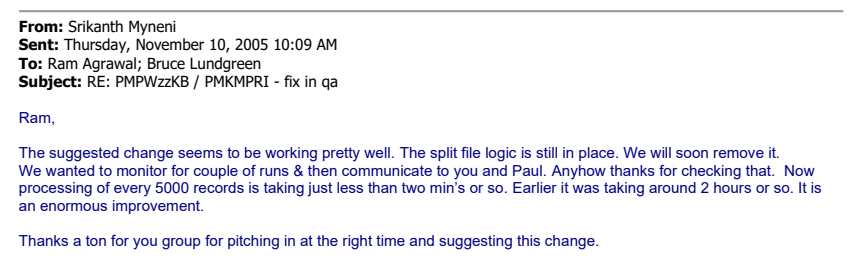
Conclusion
This case highlights the value of stepping back from traditional debugging and examining the full system flow. By focusing on behavior rather than just code, a problem considered unsolvable for years was fully resolved with a simple yet transformative solution. The conversation and idea