
This is continuation of my blog The Wonderful World of Numbers.
Let me walk through the mechanics as I understand them — Elmsley’s original insight is elegant, and once you see it you’ll have that “of course” moment I mentioned earlier.
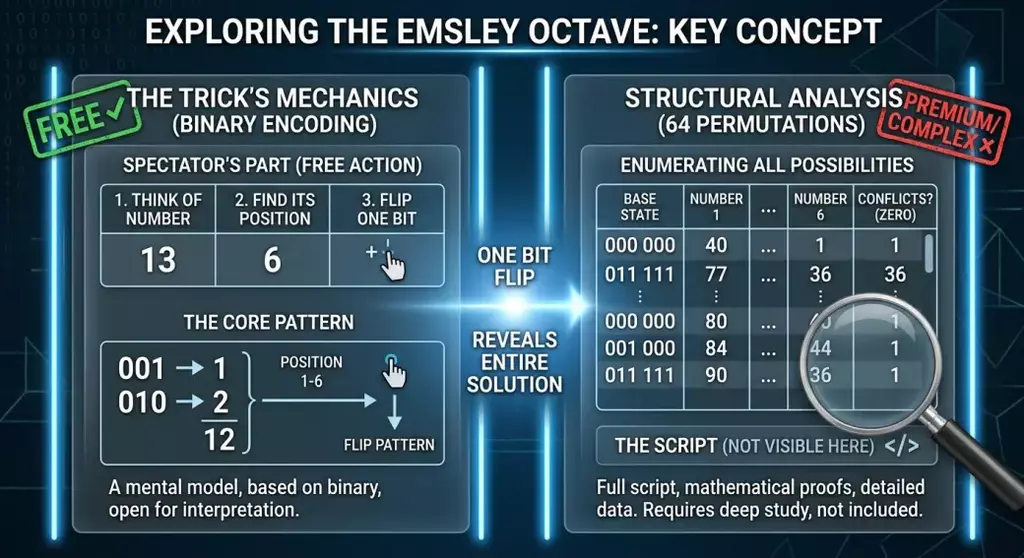
The trick is built on a simple idea: every two-digit number can be represented as two groups of three binary digits — what Elmsley called octaves.
Take the number 12. In binary octaves, 1 = 001 and 2 = 010, so 12 becomes 001 010 — six binary digits split into two groups of three. Left group = tens digit. Right group = units digit.
Here’s where it gets physical. Six numbers are written on a card and each one is marked as either a circle (0) or a square (1) — encoding the base number 12 as the starting pattern:
| Position | 1 | 2 | 3 | 4 | 5 | 6 |
|---|---|---|---|---|---|---|
| Number | 52 | 32 | 2 | 16 | 10 | 13 |
| Symbol | ○ | ○ | ■ | ○ | ■ | ○ |
| Bit | 0 | 0 | 1 | 0 | 1 | 0 |
This pattern 001 010 represents 12 — which never appears as an answer.
The spectator is asked to think of any one number, then flip just that symbol — circle becomes square or square becomes circle — without saying which one they changed. The performer glances at the new pattern and calls out the number.
The reason it works: each number on the card is not random. It is carefully chosen so that flipping its position produces itself in binary.
Think of 13 → flip position 6 → 001 011 → left = 1, right = 3 → 13 ✓
Every number is self-referential. It encodes its own location. The spectator thinks they are hiding information. They are actually transmitting it — in binary — one bit at a time.
That is Elmsley's insight. The question reveals the answer. Every single time.
Down the Rabbit Hole — 64 Ways to Play
After building my own version and performing it a few times, I got curious about the underlying structure. Specifically: how many valid versions of this trick exist? Could some combinations of numbers produce conflicts or duplicates that would break it?
I wrote a small script to enumerate every possible base state — all 64 combinations between 000 000 and 111 111 — to find out.
Each bit flip changes exactly one octave by exactly one bit, which changes exactly one digit of the result. Two different flips can never produce the same number. Conflicts are mathematically impossible, baked into the design of the encoding itself.
Which means there are 64 completely different versions of this trick that could be performed, each with its own set of six numbers. You could do it multiple times in the same evening and the audience would never see the pattern repeat.
| Base State | The Six Numbers |
|---|---|
| 000 000 | 40, 20, 10, 4, 2, 1 |
| 001 010 | 52, 32, 2, 16, 10, 13 mine |
| 011 111 | 77, 17, 27, 33, 35, 36 |
| 111 111 | 37, 57, 67, 73, 75, 76 |
Elmsley built the trick. The math always had 64 rooms in it — I just counted them.


Pingback: The wonderful world of numbers – Rams world